
Posted by Brent Books on Aug 7th 2025
Do I need a case trimmer for reloading?
If you are into reloading, you’ve probably come across the term "case trimmer" more than once. Some reloaders swear by it, while others might see it as an unnecessary extra step. But if you want to ensure that your ammo is precise, reliable and performs consistently, then trimming your brass is essential. Whether you are a seasoned reloader or just starting out, understanding the importance of case trimming can make a massive difference in the safety and accuracy of your rounds.
When you fire a round, the brass case expands to fit the chamber and then contracts slightly as the bullet exits. However, it does not return to its original dimensions. This process causes the case to stretch over multiple reloads and if left unchecked, this stretching can lead to chambering issues, pressure problems and a drop in accuracy. In semi-automatic rifles, the extraction process can further contribute to case stretching. A case trimmer ensures that your brass stays within the correct length specifications, preventing dangerous malfunctions and keeping your shots on target.
So, do you really need a case trimmer? And if so, which one should you get?
Why cases stretch during reloading
Brass cases do not remain the same length forever. Every time they are fired, resized and reloaded, they tend to stretch. Understanding the factors behind case stretching is key to understanding why trimming is necessary.
When a round is fired, high-pressure gases push the brass case against the chamber walls, causing it to expand. Once the bullet exits the barrel, the case contracts slightly, but it never fully returns to its original dimensions. This gradual stretching happens during each firing and becomes more pronounced over multiple reloads.
For bottleneck rifle cases like .223 Remington or 6.5 Creedmoor, the brass stretches more than straight-walled cases like .45 ACP or 9mm. In semi-automatic rifles, the violent extraction process can pull the brass lengthwise as it is ejected, leading to faster stretching. If you are shooting high-pressure loads, this expansion will be more significant and the brass will stretch faster.
With some brass, you might not need to trim after every firing, but you will need to check it regularly to ensure it is within acceptable limits. Over time, as cases are reloaded and resized, they grow longer and if not trimmed properly, they can cause malfunctions.
What happens if you skip trimming your brass?
Ignoring the trimming process might seem harmless at first, but it can lead to a number of issues, some of which can be dangerous.
First and foremost, an overgrown case might not fit properly in your rifle’s chamber. This can lead to feeding issues, especially in semi-automatic rifles. An overly long case may cause jams, prevent the bolt from closing fully, or make extraction difficult. These issues are not just annoying; they can be dangerous.
Another potential issue is increased chamber pressure. If the case is too long, it may cause the bullet to engage the rifling upon chambering, increasing start pressure and leading to unsafe pressure levels. This can cause primers to blow, cases to rupture, or even more severe firearm damage. All of this can be avoided by trimming your cases to the proper length.
Trimming your brass also ensures consistent accuracy. If your cases vary in length, this affects the bullet seating depth, which has a direct impact on accuracy. For precision shooters, this inconsistency can throw rounds off target, ruining the chances for a tight group. Even if you’re just shooting for fun, you’ll still want your rounds to perform consistently.
Lastly, trimming your cases keeps your crimps uniform. If case lengths are inconsistent, crimping pressure will vary, leading to uneven bullet retention, which can affect accuracy and pressure consistency. A consistent crimp is vital for reliable performance, especially in semi-automatics.
How often should you trim your brass?
There is no one-size-fits-all answer to how often you should trim your brass. The frequency depends on factors like the caliber you’re reloading, how many times you fire the brass and how much the brass has stretched. However, there are guidelines to help you determine when trimming is necessary.
The most important thing is to measure your brass regularly. After resizing, check the length of your cases using a caliper. If the case length exceeds the maximum length listed in your reloading manual, it’s time to trim. Some reloaders prefer to trim their cases after every firing, while others might only do it once the cases reach the maximum length.
A great way to keep track is by marking how many times each piece of brass has been reloaded. However, trimming should always be based on case length, not just the number of firings. Keep in mind that rifle brass, especially bottleneck cartridges, typically needs to be trimmed more frequently than straight-walled cases.
For precision shooters, trimming your brass to a uniform length after each firing ensures that every round is as consistent as possible, which is crucial when shooting at long distances. For casual shooters, you may not need to trim every time, but it’s still wise to check your brass regularly to avoid potential issues.
Choosing the right case trimmer
There are many different types of case trimmers on the market, ranging from manual to power-operated models. The type of trimmer you choose depends on how much brass you need to process and how precise you want to be.
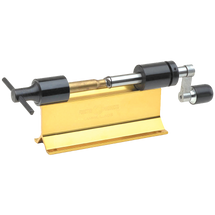
Manual trimmers are often favored by reloaders who prefer the control and precision they offer. These trimmers can be lathe-style or collet-based and they are typically adjustable to accommodate a range of calibers. While these tools require more time and effort, they provide excellent accuracy and consistency.
If you reload a lot of brass, a power case trimmer might be a better choice. Drill-powered trimmers or electric trimmers can speed up the trimming process, saving you time, especially if you have large batches of brass to process. Some trimmers also come with additional features like deburring and chamfering capabilities, allowing you to handle multiple tasks with one tool. High-end power trimmers can be just as precise as manual ones while offering greater efficiency.
For those on a budget or for those who don’t need to trim large quantities of brass, handheld case trimmers might be sufficient. These tools are easy to use and inexpensive, but they lack the precision and speed of more advanced models.
How to trim your brass properly
Trimming brass might sound intimidating at first, but once you get the hang of it, it becomes a simple and essential part of your reloading routine. Here’s a basic guide on how to properly trim your cases:
- Measure the case length with a caliper. After resizing, check the length of each piece of brass to ensure it falls within the acceptable limits.
- Secure the case in your trimmer. Most trimmers have some type of collet or chuck that holds the case in place. Ensure the case is centered to avoid uneven cuts.
- Adjust the trimmer to the desired length. Be careful to only remove a small amount of brass.
- Deburr and chamfer the case mouth. Use a deburring tool to smooth out rough edges for better bullet seating.
- Measure the trimmed cases one last time. Consistency is key, so ensure each piece is uniform before proceeding with your reloading.
Do you really need a case trimmer?
If you reload rifle ammunition, the short answer is yes, you definitely need a case trimmer. Neglecting this step can lead to dangerous malfunctions, inconsistent performance and potentially damaged firearms.
Straight-walled pistol brass rarely needs trimming, except in cases where roll crimps are used or where repeated resizing causes length variations. However, for bottleneck rifle brass, trimming is essential to keep your brass within specifications.
A good case trimmer is a wise investment for anyone serious about reloading. Whether you reload for precision, reliability or just for fun, keeping your brass in top shape is critical.
Find the right case trimmer at Creedmoor Sports
At Creedmoor Sports, we understand the importance of precision and reliability when it comes to reloading. That’s why we offer a variety of case trimmers designed to meet the needs of every reloader, from casual enthusiasts to competitive shooters. Whether you need a manual trimmer for ultimate precision or a power trimmer to speed up the process, we have the right tool for you.
